
An important part of any farm is livestock. Too many ‘farms’ these days have separated the livestock from the crops, essentially taking the needed nutrients from the place that needs it most. If you look back at farms from early settlers, they all had livestock as an integral part of the farm. I have a few types of livestock here at BeeWench Farm.
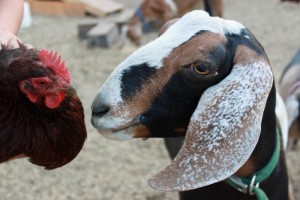
We have goats that I milk each day for all of dairy needs; milk, cheeses, yogurt and even ice cream! My son has a flock of laying hens that he sells the eggs from, to our CSA (Community Supported Agriculture) customers. I also raise two or three pigs and 75-100 meat chickens each year for our freezer.
All of the animals we raise on the farm are raised on pasture. The goats rotate through their one acre pasture and the garden each year using a strip/mob grazing plan. The pigs also spend time on pasture although they’re not given as much room as the goats, since they’re only part of the farm for a short period of time.
The chickens rotate behind the goats in the garden area and certain parts of the farm, specifically in the ‘soon-to-be’ orchard area. In the garden, the goats spend a short period of time ‘cleaning up’ what’s left of the plants from the growing season. Not only do they do a GREAT job clearing away any leftovers, they leave all sorts of great fertilizer behind. Then the laying hens are moved to that area in their ‘egg mobile’ to do their job. They spend time eating bugs, scratching through and spreading the goat fertilizer and scratching away any other green leftovers. The goats are then moved to the next spot and so on and so on.
The meat chickens are moved around a little differently. Instead of an ‘off the ground’ trailer like the laying hens, they are housed in low to the ground ‘chicken tractors’. These tractors are moved every few days across the area of pasture they’re working. Now, don’t get me wrong, chickens can’t live on just grass. They do need to be supplemented with some grains (non-GMO) but they eat very little of it. This link shows a few great pictures of what a pasture looks like after a chicken tractor has gone through it. And these are the chicken tractors we use (will be using) here at BeeWench Farm. These are easily movable and I like the fact that I can get inside them to fill feeders or waterers.
Meat chickens take approximately nine weeks to grow to butchering size. They spend about three weeks in the brooder before being put out in the pasture. I can cover a good amount of area with each batch of chickens (50 or so per tractor) over their six week growing period.
Pasturing poultry takes careful management and a little more work than ‘traditional’ poultry raising. However, the return far outweighs the extra work. My soil is healthier and the costs of raising the birds is less than an ‘all bagged feed diet’.
No responses yet